
Keywords
Foreign Investment
Economic Diplomacy
Tributary System
Sovereignty
How to Cite
Abstract
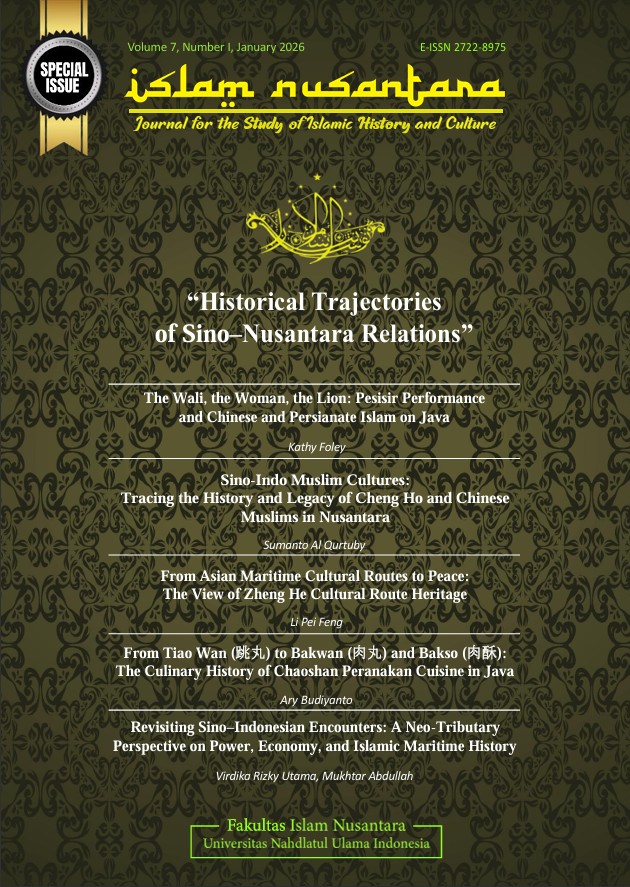
Patterns of Indonesia–China relations over the past two decades reveal an increasingly asymmetrical economic partnership shaped by large-scale investment in infrastructure and extractive industries. Strategic projects, such as the high-speed railway and nickel processing, illustrate how financial and technological dependence has deepened Indonesia’s structural vulnerability within the bilateral relationship. Interpreting these developments through the historical logic of the tributary system sheds light on emerging power hierarchies that resemble a modern neo-tributary order. Evidence from academic studies and media sources underscores the need for a more autonomous and strategically calibrated foreign policy to safeguard national sovereignty amid intensifying regional competition.
Bibliography
Andika, M. T., & Aisyah, A. N. (2017). Analisis politik luar negeri Indonesia-China di era Presiden Joko Widodo: Benturan kepentingan ekonomi dan kedaulatan? Indonesian Perspective, 2(2), 161–179.
BBC Indonesia. (2023). Bunga utang keteta cepat Jakarta-Bandung 3,4%, jebakan utang China? BBC Indonesia. https://www.bbc.com/indonesia/articles/c72vg2v5732o
CNBC Indonesia. (2023). Top! Nilai perdagangan RI & China tembus Rp 2.041 triliun. CNBC Indonesia. https://www.cnbcindonesia.com/news/20231019071141-4-481787/top-nilai-perdagangan-ri-china-tembus-rp-2041-triliun
CNN Indonesia. (2023). China punya 15.906 proyek di Indonesia. CNN Indonesia. https://www.cnnindonesia.com/ekonomi/20230404194047-92-933588/china-punya-15.906-proyek-di-indonesia
Creswell, J. W. (2014). Research design: Qualitative, quantitative, and mixed methods approaches (4th ed.). Sage Publications.
Doğan, A. (2021). Hegemony with Chinese characteristics: From the tributary system to the Belt and Road Initiative. Routledge.
Fauziyyah, P. Z., & Paksi, A. K. (2023). Dampak kerja sama Indonesia-China dalam proyek investasi nikel terhadap pertumbuhan ekonomi kedua negara. Jurnal Ilmiah Dinamika Sosial, 7(1), 86–105.
Groeneveldt, W. P. (2018). Nusantara dalam catatan Tionghoa. Komunitas Bambu.
Hobson, J., & Zhang, S. (2022). The return of the Chinese tribute system? Re-viewing the Belt and Road Initiative. Global Studies Quarterly, 2(4). https://doi.org/10.1093/isagsq/ksac074
Humas Sekretariat Kabinet RI. (2023). Implementasi ASEAN outlook on the Indo-Pacific melalui ASEAN Indo-Pacific forum 2023: Kemanfaatan dan tantangan. Sekretariat Kabinet RI. https://setkab.go.id/implementasi-asean-outlook-on-the-indo-pacific-melalui-asean-indo-pacific-forum-2023-kemanfaatan-dan-tantangan/
JATAM. (2024). Penaklukan dan perampokan Halmahera: IWIP sebagai etalase kejahatan strategis nasional negara-korporasi. https://dokumen.jatam.org/66a8c5122b1cb_20240730_174850.pdf
Kementerian Investasi/BKPM. (2023). Buku statistik realisasi investasi berdasarkan sektor tahun 2022. BKPM.
Kontan. (2013). Xi Jinping kunjungi Indonesia 2–3 Oktober 2013. Kontan. https://nasional.kontan.co.id/news/xi-jinping-kunjungi-indonesia-2-3-oktober-2013
Liang, L. (2012). Dari relasi upeti ke mitra strategis: 2.000 tahun perjalanan Tiongkok-Indonesia. Buku Kompas.
Mandhana, N. (2016). US to access Indian bases. The Wall Street Journal.
Putten, F.-P. van der, & Petkova, M. (2021). The geopolitical relevance of the BRI: The Jakarta-Bandung high-speed railway in Indonesia. In F. Schneider (Ed.), Global perspectives on China’s belt and road initiative: Asserting agency through regional connectivity (pp. 197–216). Amsterdam University Press. https://doi.org/10.2307/j.ctv1dc9k7j.11
Rakhmat, M. Z. (2024). Xi Jinping terpilih lagi: Untung buat Indonesia, tapi gelombang protes yang sedang terjadi dapat memperburuk sentimen anti-Cina. The Conversation. https://theconversation.com/xi-jinping-terpilih-lagi-untung-buat-indonesia-tapi-gelombang-protes-yang-sedang-terjadi-dapat-memperburuk-sentimen-anti-cina-196487
Ricklefs, M. C. (2013). Sejarah Asia Tenggara: Dari masa prasejarah sampai kontemporer. Komunitas Bambu.
Shaidra, A. (2023). Dampak dominasi Cina di smelter nikel. Tempo. https://www.tempo.co/ekonomi/dampak-smelter-nikel-cina-403749
Singgih, V. (2024). Setumpuk masalah di balik investasi China - "Demam nikel membuat pemerintah kehilangan akal sehat". BBC News Indonesia. https://www.bbc.com/indonesia/articles/cw4m1k0j7vro
Trend Asia. (2024). Keselamatan buruh tergadai murah di industri hilirisasi. https://trendasia.org/wp-content/uploads/2024/06/Rilis-Kecelakaan-Berulang-Nikel-IMIP.pdf
Wienanto, S. A. (2024). Setelah Prabowo bertemu Xi Jinping: Ribut-ribut Laut Cina Selatan. Majalah Tempo. https://www.tempo.co/internasional/prabowo-subianto-laut-cina-selatan--1172492

This work is licensed under a Creative Commons Attribution-NonCommercial 4.0 International License.
Copyright (c) 2025 Virdi, Abdul