
Keywords
China
Chinese Muslim
Indonesian Islam
Java
How to Cite
Abstract
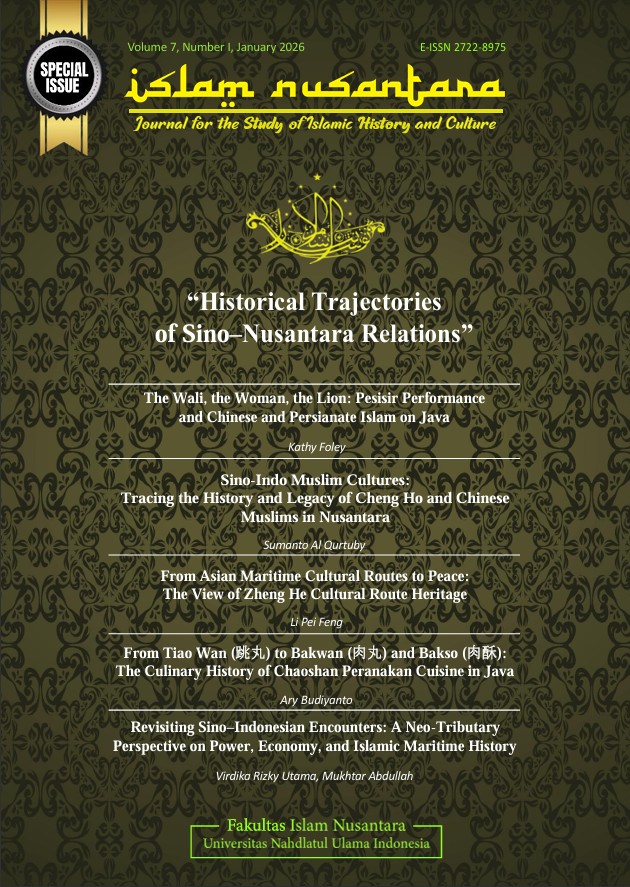
This study re-examines the formation of Muslim communities in the Malay–Indonesian world through the presence of Zheng He, with particular attention to the role of Chinese Muslim networks in the early history of Islam in Indonesia. Employing a qualitative approach grounded in historical and library-based research, the study focuses its analysis on Javanese historical evidence related to diplomacy, maritime networks, and religious life prior to the period of European expansion. The findings demonstrate that Chinese Muslim networks were deeply embedded in diplomatic relations, maritime trade, and religious practices in the archipelago from an early period. Chinese Muslim influences contributed to the shaping of local Islamic practices while also broadening the cultural horizons of early Muslim communities in the region. A reassessment of several dominant Islamization theories further suggests that Sino-Indonesian Muslim interactions provide strong grounds for recognizing the “Chinese theory” as an important perspective alongside Arab, Persian, and Indian theories. This article makes a significant contribution to scholarship on Islamization and the history of Islam in the Malay–Indonesian world by affirming the plural genealogies of Indonesian Islam and enriching analytical frameworks on diaspora, mobility, and intercultural exchange in the making of Muslim societies in Nusantara.
Bibliography
Al Qurtuby, S. (2003). Arus China Islam Jawa: Membongkar sejarah peranan Tionghoa dalam proses Islamisasi di Nusantara pada abad ke-15 dan 16. Inspeal Press.
Ambary, H. M. (2001). Menemukan peradaban: Jejak arkeologis dan historis Islam Indonesia. Logos Wacana Ilmu.
Anonym. (1997). Laporan akhir penelitian tentang menelusuri jejak-jejak sejarah Islam di Kotamadya Semarang. Semarang.
Atjeh, A. (1955). Sedjarah Mesdjid. n.p.
Atmodarminto, R. (2000). Babad Demak dalam tafsir sosial politik. Millennium Publisher.
Azra, A. (n.d.). Jaringan ulama Timur Tengah dan Kepulauan Nusantara abad XVII dan XVIII. Mizan.
Babad Tanah Djawi. (1939-1941). Babad Tanah Djawi. Balai Pustaka.
Berg, C. C. (1955). The Islamization of Java. Studia Islamica, 4, 111-142. https://doi.org/10.2307/1595054
Broomhall, M. (1905). Islam in China: A neglected problem. Morgan & Scott Limited.
Budiman, A. (1979). Masyarakat Islam Tionghoa di Indonesia. Penerbit Tanjung Sari.
Choy, L. K. (1977). Indonesia between myth and reality. Federal Publication.
De Graaf, H. J., & Pigeaud, T. G. Th. (1984). Chinese Muslims in Java in the 15th & 16th centuries: The Malay Annals of Semarang and Cerbon. Monash University.
De Graaf, H. J., & Pigeaud, T. G. Th. (1976). Islamic state in Java 1500-1700: A summary, bibliography and index. KITLV. https://doi.org/10.1163/9789004287006
De Graaf, H. J., & Pigeaud, T. G. Th. (1981). Surabaya dalam abad ke XVII: Dari kerajaan sampai kabupaten. Jarahnitra.
Djajadiningrat, H. (1983). Tinjauan kritis tentang sejarah Banten. Djambatan.
Drewes, G. J. W. (1985). New light on the coming of Islam to Indonesia? In A. Ibrahim, S. Siddique, & Y. Husein (Eds.), Reading Islam in Southeast Asia. Institute of Southeast Asian Studies.
Edel, J. (1938). Hikayat Hasanuddin. Ten Brink.
Groeneveldt, W. P. (1960). Historical notes on Indonesia and Malaya compiled from Chinese sources. Bhratara.
Huan, M. (1970). Ying-yai Sheng-lan: The overall survey of the ocean's shores (Original work published 1433). Hakluyt Society.
Ibn Battuta. (1964). The travels of Ibn Battuta (T. Harb, Ed.). Dar Beirut.
Ignatius, A. (2001, August 20-27). The Asian voyage: In the wake of the admiral. Time Magazine. https://time.com/archive/6955555/the-asian-voyage-in-the-wake-of-the-admiral-2/
Israeli, R. (1980). Muslims in China: A study in cultural confrontation. Curzon Press.
Joe, L. T. (1931). Riwayat Semarang: Dari zamannya Sam Poo sampai terhapusnya Kongkoan. Boekhandel Ho Kim Yoe.
Ju-Kua, C. (1965). Chau Ju Kua: His works on the Chinese and Arab trade in the 12th & 13th centuries. Cheng Wen Publishing Company.
Kuwabara, J. (1928). On P'u Shou Keng: A man of the Western regions... Toyo Bunko.
Lan, N. J. (1952). Tiongkok sepanjang abad. Balai Pustaka.
Lin, L. H. (1967). Islam in Canton in the Sung period: Some fragmentary records. In F. S. Drake & Wolfram (Eds.), Symposium on historical archeological and linguistics: Studies on Southern China, Southeast Asia and the Hong Kong region. Hong Kong University Press.
Lombard, D. (1996). Nusa Jawa silang budaya. Gramedia.
Lombard, D., & Salmon, C. (1993). Islam and Chineseness. Indonesia, 57, 115-131. https://doi.org/10.2307/3351244
Ma, I. T. Y. (1979). Perkembangan Islam di Tiongkok. Bulan Bintang.
Marsono. (1988). Serat Kandaning Ringgit Purwa menurut naskah tangan LOr 6379 Perpustakaan Universitas Leiden, Jilid 9. Djambatan.
Muljana, S. (1968). Runtuhnja keradjaan Hindu-Djawa dan timbulnja negara-negara Islam di Nusantara. Bhratara.
Palindungan, M. O. (1969). Tuanku Rao. Penerbit Tandjung Pengharapan.
Pires, T. (1944). Suma Oriental (A. Cortesao, Ed.; 2 vols.). The Hakluyt Society.
Reid, A. (2017). Female roles in pre-colonial Southeast Asia. In M. MacLeod & E. Rawski (Eds.), European intruders and changes in behavior and customs in Africa, America, and Asia before 1800. Routledge. https://doi.org/10.4324/9781315255934-18
Seagrave, S. (1999). Para pendekar pesisir: Sepak terjang gurita bisnis Cina rantau. Alvabet.
Seong, T. Y. (1963). Chinese element in the Islamization of Southeast Asia: A study of the strange story of Njai Gede Pinatih, the grand lady of Gresik. Taiwan Provincial Museum.
Silado, R. (2004). Sam Po Kong: Perjalanan pertama. Gramedia.
Schrieke, B. (1957). Ruler and realm in early Java. W. van Hoeve.
Stutterheim, W. F. (1948). De Kraton van Majapahit. Brill. https://doi.org/10.26530/OAPEN_613414
Toer, P. A. (2001). Arus balik: Sebuah epos pasca kejayaan Nusantara di awal abad ke-16. Hasta Mitra.
Van Leur, J. C. (1955). Indonesian trade and society. W. van Hoeve.
Van den Berg, L. W. C. (1989). Hadramaut dan koloni Arab di Nusantara. KITLV.
Vlekke, B. H. M. (1943). Nusantara: A history of the East Indian Archipelago. Harvard University Press. https://doi.org/10.2307/2263037
Wardi, S. (1950). Koempoelan cerita lama dari Kota Wali. Wahju.
Zen, T. (1998). Manaqib Wali Tujuh di Bali dan raja-raja Islam di Indonesia. n.p.
Zhi, K. Y. (1996). Sam Po Kong dan Indonesia. Haji Masagung.

This work is licensed under a Creative Commons Attribution-NonCommercial 4.0 International License.
Copyright (c) 2025 Sumanto Qurtuby