
Keywords
Melaka Malays
Vernacular architecture
How to Cite
Abstract
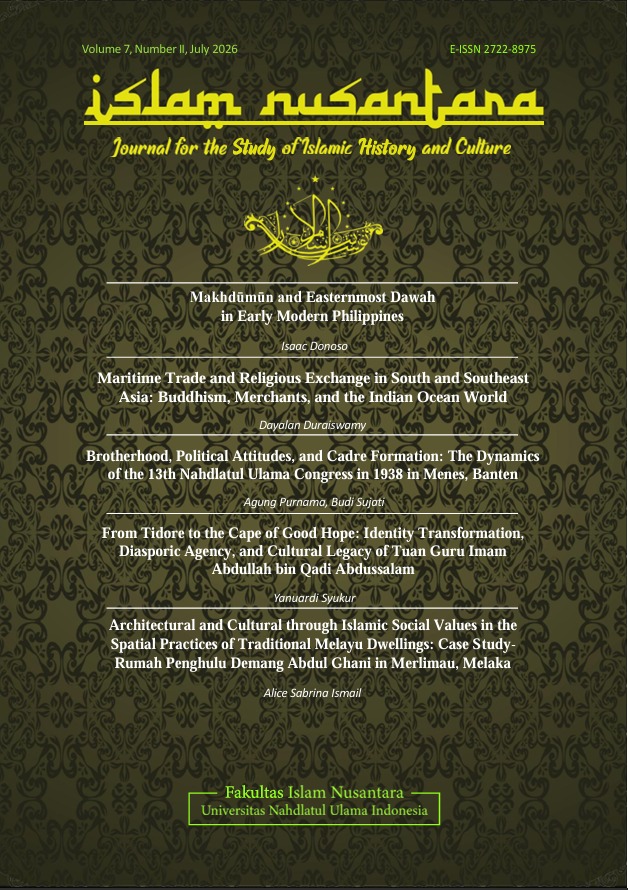
This paper investigates how the cultural and Islamic social values of the Melayu Melaka community shape, regulate, and sustain the spatial, material, and symbolic dimensions of residential architecture in Malacca. Rooted in centuries of historical stratification, processes of Islamisation, mercantile cosmopolitanism, and locally embedded adat, the Melayu Melaka worldview is articulated through the organisation of domestic space, dwelling practices, material culture, and architectural ornamentation. Adopting a qualitative, interpretive research methodology informed by architectural anthropology, vernacular architecture studies, and cultural history, the study argues that core cultural and Islamic social values—such as propriety, religiosity, communal cooperation, and social harmony—are materially and spatially inscribed within house typologies, spatial sequencing, construction techniques, threshold rituals, and the aesthetic language of domestic ornamentation. Through an analysis of classical kampung houses, the paper demonstrates that these values not only inform architectural form-making but also operate as cultural drivers that mediate social relations, reinforce collective identity, and regulate everyday life. The study concludes by positioning the Melayu Melaka house as a form of living moral architecture, continuously negotiated across generations, and emphasises that the safeguarding of this moral–architectural heritage is essential for sustaining cultural resilience amid modernisation and the pressures of global tourism.
Bibliography
Abd Razak, N. S., & Husin, W. N. H. W. (2011). Hubungan Sosial Antara Komuniti Mela Yu Den Gan Komuniti Bukan Melayu Mengikut Perspektif Peradaban: Satu Pengenalan: Social Interaction Between Malay And Non-Malay Communities According To Civilisational Perspective: An Introduction. Jurnal Pengajian Melayu (JOMAS), 22(1), 205-233.
Ali, K. K. (2022). A Discourse On The Malay Cultural Identity Within The Malaysian Society. Kajian Malaysia: Journal of Malaysian Studies, 40(1). https://doi.org/10.21315/km2022.40.1.5
Amat, S. C., & Rashid, M. S. A. (2014). An analysis of the traditional malay architecture as indicators for sustainability: An introduction to its genius loci. Universiti Teknologi MARA, Perak, Malaysia.
Ani, A., Mohamed, N., & Rahman, N. A. (2012). Socio-cultural influences in the composition of traditional Malay house compounds in rural Melaka. ALAM CIPTA, International Journal of Sustainable Tropical Design Research and Practice, 5(1).
Bideau, F. G., & Kilani, M. (2012). Multiculturalism, cosmopolitanism, and making heritage in Malaysia: A view from the historic cities of the Straits of Malacca. International Journal of Heritage Studies, 18(6), 605-623. https://doi.org/10.1080/13527258.2011.609997
Chen, Y.-R., Ariffin, S. I., & Wang, M.-H. (2008). The typological rule system of Malay houses in Peninsula Malaysia. Journal of Asian Architecture and Building Engineering, 7(2), 247-254. https://doi.org/10.3130/jaabe.7.247
Eco, U. (2009). On the ontology of fictional characters: A semiotic approach. Σημειωτκή-Sign Systems Studies, 37(1-2), 82-98. https://doi.org/10.12697/SSS.2009.37.1-2.04
Endut, E. H. (1994). Traditional Malaysian built forms: a study of the origins, main building types, development of building forms, design principles and the application of traditional concepts in modern buildings University of Sheffield].
Goh, D. P. (2014). Between history and heritage: Post-colonialism, globalisation, and the remaking of Malacca, Penang, and Singapore. TRaNS: Trans-Regional and-National Studies of Southeast Asia, 2(1), 79-101. https://doi.org/10.1017/trn.2013.17
Hidayat, W. (2011). Application of Malay traditional architecture elements as regional identity towards sustainable city. RUAS, 9(2), 1-27. https://doi.org/10.21776/ub.ruas.2011.009.02.4
Husin, W. N. W. (2010). Budi-Islam: It's role in the construction of Malay identity in Malaysia. International Journal of Humanities and Social Science, 1(12), 132-142.
Ibrahim, I., Roslee, N., Abdullah, A., Ibrahim, M., & Murtaza, F. F. N. (2020). Analysis on the socio-cultural values of the traditional Malay houses compound. Planning Malaysia, 18. https://doi.org/10.21837/pm.v18i12.747
Ishak, M., & Abdullah, O. C. (2012). Islam and the Malay world: An insight into the assimilation of Islamic values. World Journal of Islamic History and Civilization, 2(2), 58-65.
Ismail, N., Ahmad Zakaria, R. M., Ramli, Z. R., Farriehah Azizan, N., & Norman, M. R. (2020). Advanced Technology of 18th-20th Century Roof Crown as a Decorative Arts Islamic Mosque in Central Malacca, Malacca. International Journal of Advanced Research in Engineering and Technology, 11(6).
Jamian, M. N., & Radzi, S. B. M. (2013). In search of a just leader in Islamic perspective: An analysis of traditional Malay literature from the perspective of adab. Asian Social Science, 9(6), 22. https://doi.org/10.5539/ass.v9n6p22
Jee Yuan, L. (1987). The Malay House: Rediscovering Malaysia's Indigenous Shelter System. Kuala Lumpur: Insitut Masyarakat.
Kamal, K. S., Wahab, L. A., & Ahmad, A. C. (2004). Climatic design of the traditional Malay house to meet the requirements of modern living. The 38th International Conference of Architectural Science Association ANZAScA "Contexts of architecture, Kohl, David G. (1984) Chinese Architecture in the Straits Settlements and Western Malaya: Temples, Kongsis, and Houses,Heinemann Asia
Lawless, J. W. (2015). Melaka as a cultural landscape. Journal of Space and Communication, 1(1), 37-45. https://doi.org/10.15340/2148172511920
Mohd Nor, M., Mohd Noor, N., & Shimoda, S. (2020). Street Network: Physical and Cultural Transformations on the Morphology of Historical City of Malacca. Journal of Chinese Architecture and Urbanism, 2(2), 972. https://doi.org/10.36922/jcau.v2i2.972
Othman, A. A., Jali, M. F. M., Besar, J. A., & Abas, A. (2019). Regional historiography of Malacca Straits and the civilizational discourse on post-colonial communities. International Journal of Advanced and Applied Sciences, 6(11), 75-80. https://doi.org/10.21833/ijaas.2019.11.010
Pepinsky, T. (2019). Adab and the Culture of Political Culture. Piety, Politics, and Everyday Ethics in Southeast Asian Islam: Beautiful Behavior, 59.
Rahil, N. R. M., Ghani, M. Z. A., & Sarkom, Y. (2020). Architectural heritage values and sense of place of Kampung Morten, Melaka. Planning Malaysia, 18. https://doi.org/10.21837/pm.v18i14.816
Rahman, A. A., Hasshim, S. A., & Rozali, R. (2015). Residents' preference on conservation of the Malay traditional village in Kampong Morten, Malacca. Procedia-social and behavioral sciences, 202, 417-423. https://doi.org/10.1016/j.sbspro.2015.08.246
Raja Abdul Kadir, T. A. Q., Jahn Kassim, P. S., & Sapian, A. R. (2024). Assessing aristocratic architectural styles through the Malay classical evaluation tool. Built Environment Journal, 21, 274-291. https://doi.org/10.24191/bej.v21iSI.1881
Reid, A. (2001). Understanding Melayu (Malay) as a source of diverse modern identities. Journal of Southeast Asian Studies, 32(3), 295-313. https://doi.org/10.1017/S0022463401000157
Rouffaer, G., & Winstedt, R. (1922). The Early History OF Singapore, Johore & Malacca. Journal of the Straits Branch of the Royal Asiatic Society(86), 257-260.
Wiryomartono, B. (2019). Urbanism, Society, and Culture in the Malay Peninsular World: Bandar Malacca. In Livability and Sustainability of Urbanism: An Interdisciplinary Study on History and Theory of Urban Settlement (pp. 205-238). Springer. https://doi.org/10.1007/978-981-13-8972-6_9
Yaman, M., Rozali, N. F., & Abdullah, F. (2023). An investigation of significant architectural settings of a Malacca traditional mosque: a case study of Tengkera mosque. Built Environment Journals, 20(2), 70-87.
Yaman, Y. N. A., Ramele, R., & MuhamadAriff, N. R. (2018). The alteration on the spatial elements of Traditional Malay House at heritage village of Malacca. e-Academia Journal, 8, 16-22.
Zakaria, J., Yaakob, A. F., & Zawawi, H. Y. (2022). Social cohesion for community development in Malaysia: Impact to national integration. International Journal of Academic Research in Business and Social Sciences, 12(11), 1293-1305. https://doi.org/10.6007/IJARBSS/v12-i11/15651

This work is licensed under a Creative Commons Attribution-NonCommercial 4.0 International License.
Copyright (c) 2026 Alice Sabrina Ismail