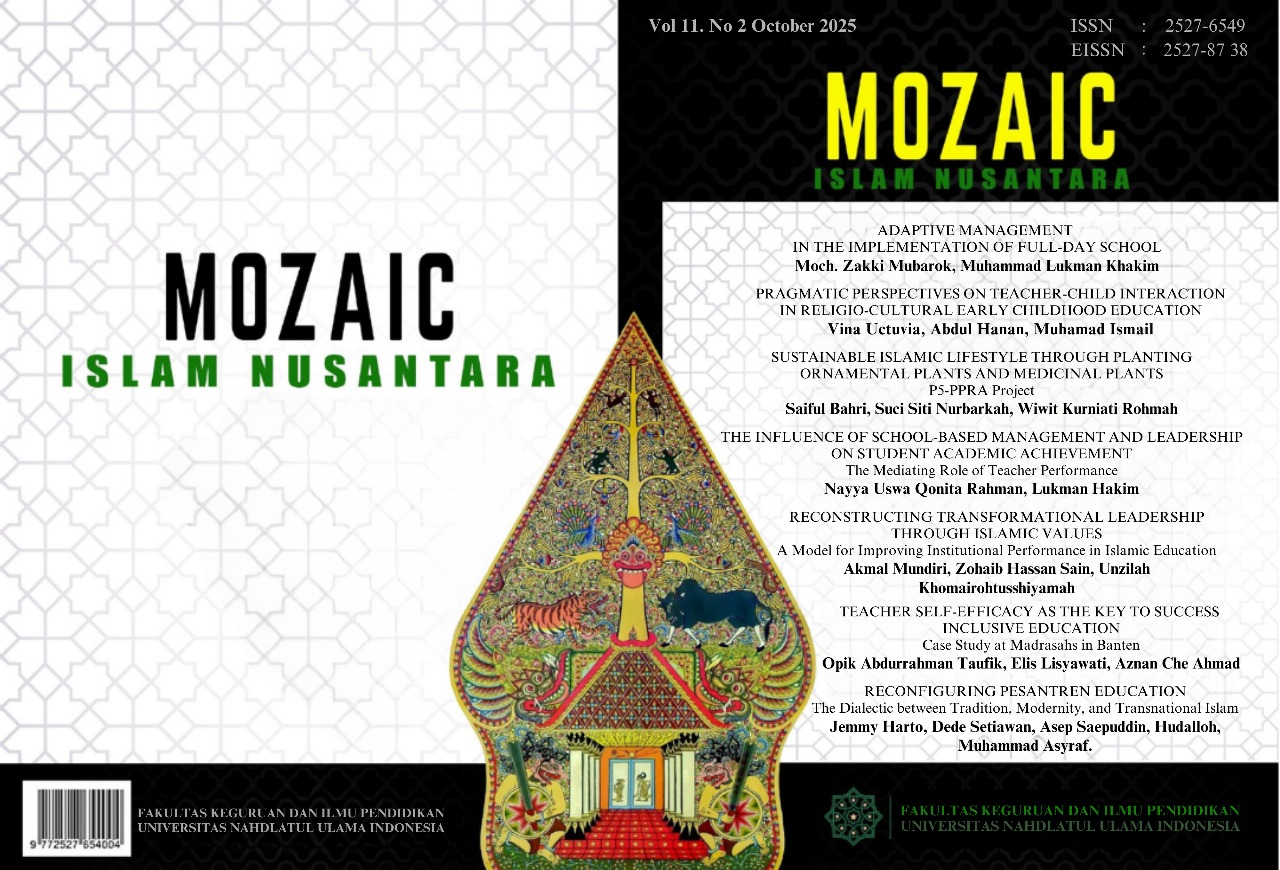
Adaptive Management in the Implementation of Full-Day School
DOI:
https://doi.org/10.47776/mozaic.v11i2.1765Keywords:
Adaptive Management, Continuous Evaluation, Full-Day School, Instructional Leadership, Islamic EducationAbstract
Full-Day School (FDS) in Islamic elementary education requires adaptive management grounded in instructional leadership theory to integrate academic and religious learning within extended daily schedules. This study analyzed the planning, implementation, and evaluation of the FDS program at SD Islam Plus Al-Haqiqi, Sidoarjo, as well as the supporting and inhibiting factors influencing its sustainability. Using a descriptive-qualitative approach with 32 purposively selected participants, data were collected through in-depth interviews, participatory observations, and document analysis, and analyzed using the Miles Huberman Saldaña interactive model. The findings reveal that participatory adaptive planning aligned the national curriculum with Islamic character education goals; teachers enacted dual roles as instructional leaders through flexible pedagogy and structured active breaks; and continuous adaptive evaluation enabled rapid instructional adjustments. Institutional commitment, teacher efficacy, and parental involvement supported the program, while limited infrastructure and student fatigue posed challenges. The study proposes an adaptive-leadership model for Islamic schools with limited resources and recommends the use of well-being-oriented evaluation instruments, targeted professional development in adaptive leadership, and appropriate educational technologies to strengthen the program’s long-term sustainability.
References
Abitama, R. R., Abror Rahmat, M., Subkhan, M., & Ginanjar, D. (2024). Sekolah Adaptif: Strategi Membangun Budaya Organisasi yang Responsif terhadap Perubahan. Jurnal Sadewa : Publikasi Ilmu Pendidikan, Pembelajaran Dan Ilmu Sosial, 2(4), 145–151. https://doi.org/10.61132/sadewa.v2i3.1239
Anderson, R. C., Katz-Buonincontro, J., Livie, M., Land, J., Beard, N., Bousselot, T., & Schuhe, G. (2022). Reinvigorating the Desire to Teach: Teacher Professional Development for Creativity, Agency, Stress Reduction, and Wellbeing. Frontiers in Education, 7. https://doi.org/10.3389/feduc.2022.848005
Arifin, Z., & Sholihah, H. W. (2024). Manajemen Kurikulum Sekolah Berbasis Full Day School Dalam Penanaman Budaya Pesantren di Sekolah Menengah Pertama. Manajeria, 3(2), 2024. https://doi.org/10.52431/manajeria.v2i2
Aspers, P., & Corte, U. (2019). What is Qualitative in Qualitative Research. Qualitative Sociology, 42(2), 139–160. https://doi.org/10.1007/s11133-019-9413-7
Aust, L., Linker, J. C., Eichholz, L., Schiffer, J., Nührenbörger, M., Selter, C., & Souvignier, E. (2025). How much formalization of assessment methods is useful when implementing formative assessment in second grade mathematics classrooms? Contemporary Educational Psychology, 81. https://doi.org/10.1016/j.cedpsych.2025.102376
Botvin, M., Hershkovitz, A., & Forkosh-Baruch, A. (2023). Data-driven decision-making in emergency remote teaching. Education and Information Technologies, 28(1), 489–506. https://doi.org/10.1007/s10639-022-11176-4
Braun, V., & Clarke, V. (2021). One size fits all? What counts as quality practice in (reflexive) thematic analysis? Qualitative Research in Psychology, 18(3), 328–352. https://doi.org/10.1080/14780887.2020.1769238
Castillo-Montoya, M. (2016). Preparing for interview research: The interview protocol refinement framework. Qualitative Report, 21(5), 811–831. https://doi.org/10.46743/2160-3715/2016.2337
Contreras, D., & Lepe, I. (2023). Extended School Day Evidence, implementation challenges and recommendations. http://www.iadb.org
Cypress, B. S. (2017). Rigor or reliability and validity in qualitative research: Perspectives, strategies, reconceptualization, and recommendations. Dimensions of Critical Care Nursing, 36(4), 253–263. https://doi.org/10.1097/DCC.0000000000000253
DeJonckheere, M., & Vaughn, L. M. (2019). Semistructured interviewing in primary care research: A balance of relationship and rigour. Family Medicine and Community Health, 7(2). https://doi.org/10.1136/fmch-2018-000057
Doyle, L., McCabe, C., Keogh, B., Brady, A., & McCann, M. (2020). An overview of the qualitative descriptive design within nursing research. Journal of Research in Nursing, 25(5), 443–455. https://doi.org/10.1177/1744987119880234
Elfira, Rasdiana, Fitrawati, Jasman, M. W., Reski, K., Anwar, A., & Enaldi. (2024). How does principal’s instructional leadership shape teacher performance mediated by teacher self-efficacy in Indonesian education context? Frontiers in Education, 9. https://doi.org/10.3389/feduc.2024.1401394
Espinosa Andrade, A., Padilla, L., & Carrington, S. J. (2024). Educational spaces: The relation between school infrastructure and learning outcomes. Heliyon, 10(19). https://doi.org/10.1016/j.heliyon.2024.e38361
Farista, D. N. R. (2018). STRATEGI PENGELOLAAN STRES GURU WANITA BERSTATUS GURU TETAP YAYASAN SEKOLAH DASAR BERSISTEM FULL DAY SCHOOL. Jurnal Kajian Teori Dan Praktik Kependidikan, 3(1).
Flick, & Uwe. (n.d.). The SAGE Handbook of Qualitative Data Analysis.
Fohlin, L., Allodi, M. W., & Sedem, M. (2025). Collective teacher efficacy and its relationship to attitudes to inclusion of students with special educational needs in Sweden. European Journal of Special Needs Education, 40(3), 457–472. https://doi.org/10.1080/08856257.2024.2380592
Gentles, S. J., Charles, C., Ploeg, J., & Ann McKibbon, K. (2015). Sampling in qualitative research: Insights from an overview of the methods literature. Qualitative Report, 20(11), 1772–1789. https://doi.org/10.46743/2160-3715/2015.2373
Gunawan, J. (2015). ENSURING TRUSTWORTHINESS IN QUALITATIVE RESEARCH. Belitung Nursing Journal, 1(1), 10–11. https://doi.org/10.33546/bnj.4
Hadiati, E., & Jannah Jafa, N. I. N. (2025). MANAJEMEN PROGRAM FULL DAY SCHOOL DALAM MEMBENTUK KARAKTER RELIGIUS SISWA DI MTS NEGERI 2 BREBES. Al-Mahabbah : Jurnal Manajemen Pendidikan Islam, 1(2), 49–57. https://journal.bustanululum.ac.id/index.php/mahabbah
Hekimoğlu, İ., Özgen, D., & Şen, C. (2025). A Methodology for Identifying Critical Success Factors and Performance Measurement for Sustainable Schools. Sustainability (Switzerland), 17(10). https://doi.org/10.3390/su17104497
Hennink, M., & Kaiser, B. N. (2022). Sample sizes for saturation in qualitative research: A systematic review of empirical tests. Social Science and Medicine, 292. https://doi.org/10.1016/j.socscimed.2021.114523
Ismailov, M., & Chiu, T. K. F. (2022). Catering to Inclusion and Diversity With Universal Design for Learning in Asynchronous Online Education: A Self-Determination Theory Perspective. Frontiers in Psychology, 13. https://doi.org/10.3389/fpsyg.2022.819884
Julianti, H. T., & Mellita, D. (2023). The Relationship Between Teacher Creativity and Work Stress on the Performance of Generation X Elementary School Teachers in Facing Learning in the Digitalization Era. Journal of Social Work and Science Education, 4(2), 698–704. https://doi.org/10.52690/jswse.v4i2.453
Koivuhovi, S., Kilpi-Jakonen, E., Erola, J., & Vainikainen, M. P. (2025). Parental involvement in elementary schools and children’s academic achievement: A longitudinal analysis across educational groups in Finland. Research in Social Stratification and Mobility, 95. https://doi.org/10.1016/j.rssm.2024.101007
Korstjens, I., & Moser, A. (2018). Series: Practical guidance to qualitative research. Part 4: Trustworthiness and publishing. European Journal of General Practice, 24(1), 120–124. https://doi.org/10.1080/13814788.2017.1375092
Lincoln, Y. S. . (1990). Naturalistic inquiry. Sage.
Major, L., Francis, G. A., & Tsapali, M. (2021). The effectiveness of technology-supported personalised learning in low- and middle-income countries: A meta-analysis. In British Journal of Educational Technology (Vol. 52, Issue 5, pp. 1935–1964). John Wiley and Sons Inc. https://doi.org/10.1111/bjet.13116
Malterud, K., Siersma, V. D., & Guassora, A. D. (2016). Sample Size in Qualitative Interview Studies: Guided by Information Power. Qualitative Health Research, 26(13), 1753–1760. https://doi.org/10.1177/1049732315617444
Meng, Z. (2023). META-ANALYSIS OF THE EFFECTIVENESS OF PROJECT-BASED META-ANALYSIS OF THE EFFECTIVENESS OF PROJECT-BASED LEARNING APPROACH ON ACADEMIC ACHIEVEMENT IN HIGHER LEARNING APPROACH ON ACADEMIC ACHIEVEMENT IN HIGHER EDUCATION WORLDWIDE EDUCATION WORLDWIDE Part of the Higher Education Commons [The University of San Francisco]. https://repository.usfca.edu/diss
Miles, M. B., Huberman, A. M., & Saldana, J. (2019). Qualitative Data Analysis: A Methods Sourcebook (4th ed.) (4th ed.). SAGE Publications.
Mohajan, H., & Mohajan, H. K. (2017). Munich Personal RePEc Archive Two Criteria for Good Measurements in Research: Validity and Reliability Two Criteria for Good Measurements in Research: Validity and Reliability. https://mpra.ub.uni-muenchen.de/83458/
Morales Rodríguez, M. (2025). Academic Editor: Francisco. https://doi.org/10.3390/ejihpe
Nadeem, M. (2024). Distributed leadership in educational contexts: A catalyst for school improvement. Social Sciences and Humanities Open, 9. https://doi.org/10.1016/j.ssaho.2024.100835
Nashrulloh, M. I., Dwi Ramandhika Yusuf Rendi Wibowo Shaleh, R., & Negeri Sunan Kalijaga Yogyakarta -Jl Laksda Adisucipto, I. (2023). Kebijakan Full Day School di Sekolah Dasar: Problematika dan Solusinya. Sekolah Dasar: Kajian Teori Dan Praktik Pendidikan, 32(02), 212–223.
Noble, H., & Heale, R. (2019). Triangulation in research, with examples. Evidence-Based Nursing, 22(3), 67–68. https://doi.org/10.1136/EBNURS-2019-103145
Nowell, L. S., Norris, J. M., White, D. E., & Moules, N. J. (2017). Thematic Analysis: Striving to Meet the Trustworthiness Criteria. International Journal of Qualitative Methods, 16(1). https://doi.org/10.1177/1609406917733847
Nurmalasari, N., Setiawan, A., Cahyani, S., Pendidikan Islam, M., & Al Farabi Pangandaran, S. (2023). IMPLEMENTASI FULL DAY SCHOOL DALAM MEMBENTUK KARAKTER SISWA DI SMKN 1 CIMERAK. In Jurnal Riset Ilmiah (Vol. 2, Issue 2).
Palinkas, L. A., Horwitz, S. M., Green, C. A., Wisdom, J. P., Duan, N., & Hoagwood, K. (2015). Purposeful Sampling for Qualitative Data Collection and Analysis in Mixed Method Implementation Research. Administration and Policy in Mental Health and Mental Health Services Research, 42(5), 533–544. https://doi.org/10.1007/s10488-013-0528-y
Paolucci, C., Vancini, S., Bex, R. T., Cavanaugh, C., Salama, C., & de Araujo, Z. (2024). A review of learning analytics opportunities and challenges for K-12 education. In Heliyon (Vol. 10, Issue 4). Elsevier Ltd. https://doi.org/10.1016/j.heliyon.2024.e25767
Pashmforoosh, R., Irby, B. J., Lara-Alecio, R., & Tong, F. (2023). Building school leaders’ instructional leadership capacity through virtual professional leadership learning communities. Frontiers in Education, 8. https://doi.org/10.3389/feduc.2023.1168734
Peiris, D. L. I. H. K., Duan, Y., Vandelanotte, C., Liang, W., Yang, M., & Baker, J. S. (2022). Effects of In-Classroom Physical Activity Breaks on Children’s Academic Performance, Cognition, Health Behaviours and Health Outcomes: A Systematic Review and Meta-Analysis of Randomised Controlled Trials. In International Journal of Environmental Research and Public Health (Vol. 19, Issue 15). MDPI. https://doi.org/10.3390/ijerph19159479
Pinheiro, G., Matias Alves, J., & Serra, L. (2025). School leadership and organization in times of complexity: paths to a collaborative and regenerative school. Frontiers in Education, 10. https://doi.org/10.3389/feduc.2025.1657742
Rickles, J., Clements, M., Brodziak de los Reyes, I., Lachowicz, M., Lin, S., & Heppen, J. (2024). A Multisite Randomized Study of an Online Learning Approach to High School Credit Recovery: Effects on Student Experiences and Proximal Outcomes. Journal of Research on Educational Effectiveness, 17(3), 467–490. https://doi.org/10.1080/19345747.2023.2198524
Sahli Lozano, C., Wicki, M., Wüthrich, S., & Setz, F. (2025). A systematic review and meta-analysis of Collective Teacher Efficacy’s relationships with outcomes in the Job Demands-Resources model. Teaching and Teacher Education, 159. https://doi.org/10.1016/j.tate.2025.105006
Sain, M. D. (2019). Manajemen Full Day School pada Sekolah Dasar Islam Terpadu (SDIT) As-salam Kota Jayapura [DIsertasi]. Universitas Islam Negeri Alauddin Makassar.
Saldaña, J. (2021). The Coding Manual for Qualitative Researchers (4th ed.). SAGE Publications Inc.
Saunders, B., Sim, J., Kingstone, T., Baker, S., Waterfield, J., Bartlam, B., Burroughs, H., & Jinks, C. (2018). Saturation in qualitative research: exploring its conceptualization and operationalization. Quality and Quantity, 52(4), 1893–1907. https://doi.org/10.1007/s11135-017-0574-8
Siswadi. (2020). MODEL MANAJEMEN KURIKULUM PADA PROGRAM FULLDAY SCHOOL DI MADRASAH IBTIDAIYAH. Insania, 25(1).
Sortwell, A., Trimble, K., Ferraz, R., Geelan, D. R., Hine, G., Ramirez-Campillo, R., Carter-Thuiller, B., Gkintoni, E., & Xuan, Q. (2024). A Systematic Review of Meta-Analyses on the Impact of Formative Assessment on K-12 Students’ Learning: Toward Sustainable Quality Education. In Sustainability (Switzerland) (Vol. 16, Issue 17). Multidisciplinary Digital Publishing Institute (MDPI). https://doi.org/10.3390/su16177826
Tracy, S. J. . (2025). Qualitative research methods : collecting evidence, crafting analysis, communicating impact. Wiley Blackwell.
Vasileiadou, D., & Karadimitriou, K. (2021). Examining the impact of self-assessment with the use of rubrics on primary school students’ performance. International Journal of Educational Research Open, 2. https://doi.org/10.1016/j.ijedro.2021.100031
Wang, X., & Wei, Y. (2024). The influence of parental involvement on students’ math performance: a meta-analysis. In Frontiers in Psychology (Vol. 15). Frontiers Media SA. https://doi.org/10.3389/fpsyg.2024.1463359
Zahri N.A, Ach., Sari, Y. K., & Siswanto. (2025). Strategi Manajerial Adaptif dalam Pengembangan Kurikulum Pendidikan Islam di Era Society 5.0: Menjembatani Nilai Keislaman dan Tantangan Globalisasi di Sekolah. Jurnal Wahana Didaktika, 23(2).
Downloads
Published
Issue
Section
License
Copyright (c) 2025 Moch. Zakki Mubarok, Muhammad Lukman Khakim

This work is licensed under a Creative Commons Attribution 4.0 International License.



.jpg)