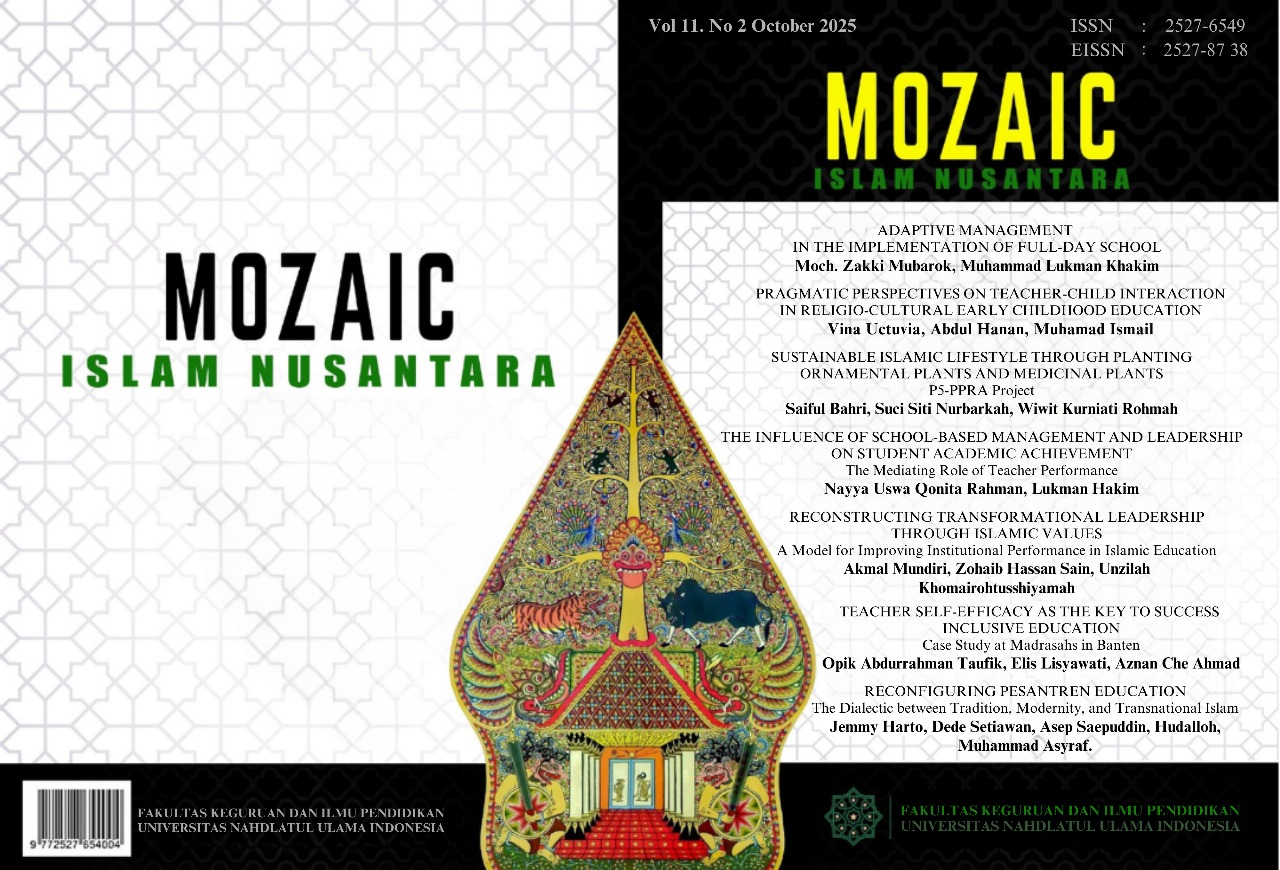
Pragmatic Perspectives on Teacher-Child Interaction in Religio-Cultural Early Childhood Education
DOI:
https://doi.org/10.47776/mozaic.v11i2.1799Keywords:
Early Childhood Education, Religio-Cultural Context, Teacher-Child InteractionAbstract
Early Childhood Education is a formative stage in children’s cognitive, social, and moral development, where teacher–child interaction contributes not only to learning outcomes but also to the internalization of cultural and religious values. In pesantren-based educational settings, these interactions are shaped by local traditions and Islamic norms. This study aims to explore the pragmatic dimensions of teacher–child interaction in a pesantren-affiliated kindergarten in Babakan, Ciwaringin, Cirebon, an area recognized for its strong Islamic educational heritage. A qualitative descriptive approach was applied. Data were collected through classroom observations, audio recordings, and semi-structured interviews with teachers. The data were transcribed and analysed using frameworks from speech act theory, politeness theory, and conversational implicature to identify the forms and functions of teacher communication. The findings show that directive speech acts are the most dominant, reflecting the teacher’s central role in classroom management, moral guidance, and ritual instruction. Expressive and representative speech acts are frequently used to provide praise, encouragement, and knowledge, while commissive and declarative acts, though less common, perform important pedagogical and spiritual functions, such as shaping discipline and reinforcing religious practices. This research contributes to pragmatics by extending its application to religio-cultural education and offers insights for educators and policymakers in designing communication strategies that are both effective and culturally responsive.
References
Al-Siyabi, M., Sisson, J., Whitington, V., Memon, N., & Harris, P. (2025). Educators Co-Constructing Religiously Responsive Pedagogies With Muslim Children and Families. Journal of Research in Childhood Education, 39(2), 384–397. https://doi.org/10.1080/02568543.2024.2448561
Alisinanoglu, F., & Kesicioglu, O. S. (2010). The effect of communication skills training on the communication skills of preschool teachers. Procedia - Social and Behavioral Sciences, 2(2), 1426–1430. https://doi.org/10.1016/j.sbspro.2010.03.212
Austin, J. L. (1962). How to do things with words. Oxford University Press.
Brown, P., & Levinson, S. C. (1987). Politeness: Some universals in language usage. Cambridge University Press.
Ceka, A., & Murati, R. (2016). The role of parents in the education of children. Journal of Education and Practice, 7(5), 61–64.
Duranti, A. (1997). Linguistic anthropology. Cambridge University Press.
Edwards, C. P. (2018). Culture and the promotion of early learning. In L. Brooker, M. Blaise, & S. Edwards (Eds.), The SAGE handbook of play and learning in early childhood (pp. 127–139). SAGE Publications. https://doi.org/10.4135/9781526470411.n12
Goodwin, C. (2000). Action and embodiment within situated human interaction. Journal of Pragmatics, 32(10), 1489–1522. https://doi.org/10.1016/S0378-2166(99)00096-X
Grice, H. P. (1975). Logic and conversation. In P. Cole & J. L. Morgan (Eds.), Syntax and semantics: Vol. 3. Speech acts (pp. 41–58). Academic Press.
Hyland, K., & Zou, H. (2022). Research on feedback in second language writing: Progress and prospects. Journal of Second Language Writing, 55, 101866. https://doi.org/10.1016/j.jslw.2021.101866
Ishihara, N., & Cohen, A. D. (2014). Teaching and learning pragmatics: Where language and culture meet. Routledge. https://doi.org/10.4324/9780203891395
Kementerian Pendidikan dan Kebudayaan. (2020). Statistik Pendidikan Anak Usia Dini 2019/2020. Pusat Data dan Statistik Pendidikan dan Kebudayaan.
Knoblauch, C. (2023). Cultural and Religious Diversity in Early Childhood Education Implications of Socialization and Education for the Geographies of Childhood. Religions, 14(4), 555. https://doi.org/10.3390/rel14040555
Levinson, S. C. (1983). Pragmatics. Cambridge University Press.
Mercer, N., & Howe, C. (2012). Explaining the dialogic processes of teaching and learning: The value and potential of sociocultural theory. Learning, Culture and Social Interaction, 1(1), 12–21. https://doi.org/10.1016/j.lcsi.2012.03.001
Miles, M. B., Huberman, A. M., & Saldaña, J. (2014). Qualitative data analysis: A methods sourcebook (3rd ed.). SAGE Publications.
Musthafa, B. (2018). Early childhood care and education in Indonesia: An analysis of current issues. Southeast Asian Journal of Early Childhood Education, 7(1), 1–14. https://doi.org/10.21009/SEAJECED.v7i1.1
Oktavia, R. (2021). Speech acts in teacher–student interaction in kindergarten: A pragmatic analysis. Journal of Early Childhood Education Research, 10(2), 211–225.
Pratiwi, H., Dwiningrum., Astuti, S.I., Riwanda, A., Minasyan, S. (2024) Insights into Multicultural Competence of Early Childhood Teacher Candidates in Indonesian Islamic Higher Education. EDUKASI: Jurnal Penelitian Pendidikan Agama Dan Keagamaan, 22(1), 79-96. https://doi.org/10.32729/edukasi.v22i1.1813
Rahman, F. (2019). Religious expressions in Islamic schools in Indonesia: A pragmatic perspective. Indonesian Journal of Applied Linguistics, 9(2), 463–471. https://doi.org/10.17509/ijal.v9i2.20220
Saville-Troike, M. (2003). The ethnography of communication: An introduction (3rd ed.). Blackwell Publishing.
Searle, J. R. (1979). Expression and meaning: Studies in the theory of speech acts. Cambridge University Press.
Siraj-Blatchford, I. (2010). Learning in the early years. In A. Alexander, C. Doddington, J. Gray, L. Hargreaves, & R. Kershner (Eds.), The Cambridge primary review research surveys (pp. 59–74). Routledge.
Susanti, W., Nurdin, S., & Wirman, E. (2023). Parent and Child Interaction Models in Islamic-Based Family Education. Indonesian Journal of Religion and Society, 5(2), 125-137. doi:https://doi.org/10.36256/ijrs.v5i2.336
UNESCO. (2021). Early childhood care and education. UNESCO. https://unesdoc.unesco.org/ark:/48223/pf0000379873
Yule, G. (2020). Pragmatics (2nd ed.). Oxford University Press.
Yusuf, M.S., Pajarianto, H., & Sulaiman, B., (2025), ‘A collaborative parent-teacher model for religious moderation education in early childhood in Indonesia’, South African Journal of Childhood Education 15(1), a1593. https://doi.org/10.4102/sajce.v15i1.1593
Zamzami, L. (2020). Islamic greetings and their pragmatic functions in pesantren communication. Journal of Pragmatics Research, 2(1), 1–15.
Downloads
Published
Issue
Section
License
Copyright (c) 2025 Vina Uctuvia, Abdul Hanan, Muhamad Ismail

This work is licensed under a Creative Commons Attribution 4.0 International License.



.jpg)