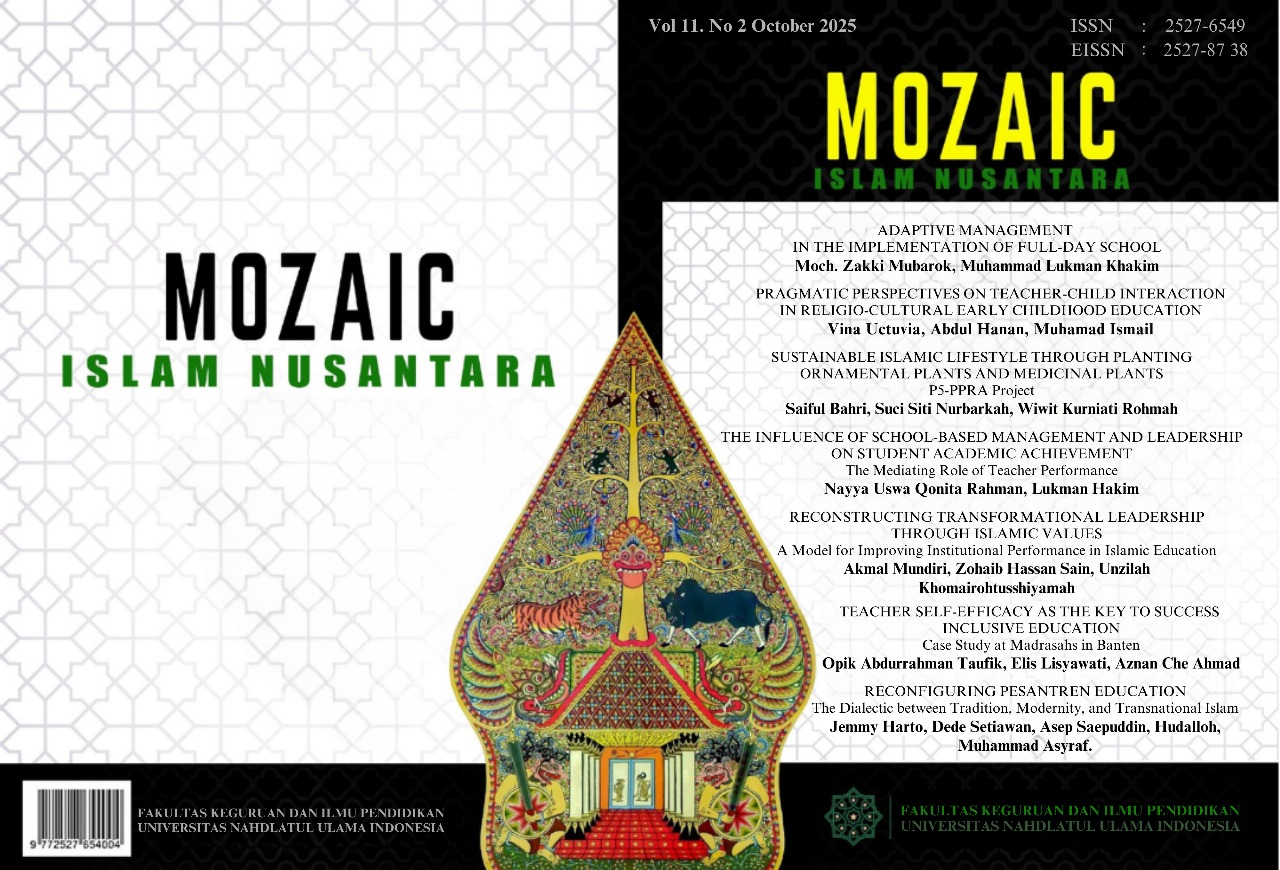
Teacher Self-Efficacy as the Key to Success Inclusive Education
Case Study at Madrasahs in Banten
DOI:
https://doi.org/10.47776/mozaic.v11i2.1804Keywords:
Inclusive Education, Madrasah, Self-EfficacyAbstract
Inclusive education aims to provide equal learning opportunities for all students, including those with special needs, by fostering collaboration and diversity within classroom environments. However, its successful implementation in Indonesia’s madrasahs remains a challenge, particularly due to limited teacher readiness and lack of special education expertise. This study explores the role of teacher self-efficacy as a key factor in the success of inclusive education in four madrasahs in Banten Province. Using a qualitative approach, data was collected through in-depth interviews, participatory observation, and documentation analysis. Thematic analysis and triangulation methods were applied to ensure data validity and reliability. The findings reveal that teachers’ self-efficacy strongly influences their motivation, classroom management, and responsiveness to the diverse needs of students with disabilities. Most assistant teachers lack formal training in special education and rely on self-directed learning or informal peer support, leading to varied implementation quality. Teachers with high self-efficacy demonstrate greater perseverance, creativity, and emotional resilience, while those with low self-efficacy tend to experience anxiety and reduced teaching effectiveness. The study highlights the importance of distributed leadership, continuous professional development, and institutional support in strengthening teacher self-efficacy. It concludes that enhancing self-efficacy among madrasah teachers is essential to sustaining inclusive education that aligns with both pedagogical goals and Islamic values of compassion and equality.
References
Al-Nur, W. R. (2023). Strategi Penerimaan Siswa Baru pada Sekolah Inklusi di School of Human Jatisampurna Bekasi. Mozaic: Islam Nusantara, 9(1), 29–43. https://doi.org/https://doi.org/10.47776/mozaic.v9i1.675
Ashari, D. A. (2021). Panduan Mengidentifikasi Anak Berkebutuhan Khusus di Sekolah Inklusi. Jurnal Obsesi : Jurnal Pendidikan Anak Usia Dini, 6(2), 1095–1110. https://doi.org/10.31004/obsesi.v6i2.1677
Baharun, H., Bali, M. M. E. I., Muali, C., & Munawaroh, L. (2020). Self-Efficacy sebagai Media Peningkatan Profesionalisme Guru di Madrasah. Risâlah, Jurnal Pendidikan dan Studi Islam, 6(1), 244–257. https://doi.org/https://doi.org/10.31943/jurnal_risalah.v6i2.158
Bahri, S., & Nuryati, N. (2024). Eksplorasi Pendidikan Inklusif: Kesetaraan dalam Pembelajaran. Jurnal Manajemen Pendidikan dan Ilmu Sosial, 5(1), 70–75. https://doi.org/10.38035/jmpis.v5i1.1812
Biantoro, O. F., & Rahmatullah, A. (2024). Pendidikan Inklusif di Indonesia: Peluang dan Tantangan. Afkaruna: International Journal of Islamic Studies (AIJIS), 2(1), 24–33. https://doi.org/10.38073/aijis.v2i1.1697
Boyle, C., Anderson, J., Allen, & Kelly-Ann. (2020). The Importance of Teacher Attitudes to Inclusive Education. In Inclusive Education: Global Issues and Controversies, 11(1), 127–146. https://doi.org/https://doi.org/10.1163/9789004431171_008
Desiriani, D., Kristiawan, M., & Wardiah, D. (2023). The Influence of Self-Efficacy and Work Environment on Teacher’s Professional Competence. Journal of Social Work and Science Education, 4(1), 120–131. https://doi.org/10.52690/jswse.v4i1.357
Ernawati, Rasyid, M. N. A., & Mania, S. (2025). Evaluasi Model CIPP pada Program Pendidikan Inklusif di SD. Learning: Jurnal Inovasi Penelitian Pendidikan dan Pembelajaran, 5(2), 509–522. https://doi.org/https://doi.org/10.51878/learning.v5i2.4869
Hanaa, H., & Mia Evani, E. (2022). Peran Penting Guru Pembimbing Khusus dalam Pendidikan Inklusi di SDI Al-Muttaqin. Jurnal Review Pendidikan Dasar : Jurnal Kajian Pendidikan dan Hasil Penelitian, 8(3), 167–171. https://doi.org/10.26740/jrpd.v8n3.p167-171
Ithriah, S. A., Ridwandono, D., & Suryanto, T. L. M. (2020). Online Learning Self-Efficacy: The Role in E-Learning Success. Journal of Physics: Conference Series, 1569(2). https://doi.org/10.1088/1742-6596/1569/2/022053
Lisyawati, E. (2025). Desain Perencanaan Pembelajaran Pendidikan Inklusif (1st ed). Unusia Press.
Lisyawati, Elis, Setyaningrum, N., & Sumarni. (2022). A Model of Inclusive Education Curriculum in Islamic Education Institutions: A Case Study in Banten Province, Indonesia. Jurnal Pendidikan Agama Islam, 19(2), 193–206. https://doi.org/10.14421/jpai.2022.192-02
Liu, J., Qiang, F., & Kang, H. (2023). Distributed Leadership, Self-Efficacy and Wellbeing in Schools: A Study of Relations among Teachers in Shanghai. Humanities and Social Sciences Communications, 10(1), 1–9. https://doi.org/10.1057/s41599-023-01696-w
Mawarny, M., Endah, & Yunus. (2025). Pendidikan Inklusi dalam Pendidikan Islam. Adab.
Muttaqya, A. T., Priyanto, A. S., Hidayah, A. N., & Meilana, S. F. (2025). Kesiapan Guru dalam Menghadapi Pendidikan Inklusi untuk Anak Beerkebutuhan Khusus. Pendas : Jurnal Ilmiah Pendidikan Dasar, 10(1), 1351–1363. https://doi.org/https://journal.unpas.ac.id/index.php/pendas/article/view/22044
Rifa’i, Y. (2023). Analisis Metodologi Penelitian Kulitatif dalam Pengumpulan Data di Penelitian Ilmiah pada Penyusunan Mini Riset. Cendekia Inovatif Dan Berbudaya, 1(1), 31–37. https://doi.org/https://doi.org/10.59996/cendib.v1i1.155
Sahna, A. R., Ningrum, N. A., Febriati, T., Masfia, I., & Fahmy, Z. (2024). Hubungan Self-Efficacy Guru dengan Sikap Guru terhadap Penyelenggaraan Pendidikan Inklusi di Sekolah Dasar di Kota Semarang. Jurnal Ilmiah Pendidikan Citra Bakti, 11(3), 832–846. https://doi.org/10.38048/jipcb.v11i3.3745
Septyana, E., Indriati, N. D., Indiati, I., & Ariyanto, L. (2023). Penerapan Pembelajaran Berdiferensiasi untuk Meningkatkan Hasil Belajar Peserta Didik Kelas X Boga 1 SMK di Semarang pada Materi Program Linear. Jurnal Sains dan Edukasi Sains, 6(2), 85–94. https://doi.org/10.24246/juses.v6i2p85-94
Setriani, S., & Puspitasari, M. (2020). Hubungan antara Self-Efficacy dengan Motivasi Belajar di SMA Darul Fattah Bandar Lampung. Jurnal Psychomutiara, 3(2), 10–16. https://doi.org/10.51544/psikologi.v3i2.1532
Sri Florina Laurence Zagoto. (2019). Efikasi Diri dalam Proses Pembelajaran. Jurnal Review Pendidikan dan Pengajaran, 2, 388–390. https://journal.universitaspahlawan.ac.id/index.php/jrpp/article/view/667
Sulastika, R., Wardiah, D., & Rahman, A. (2025). Efektivitas Kepemimpinan, Budaya Sekolah, dan Self-Efficacy terhadap Kinerja Profesional Guru. Pendas : Jurnal Ilmiah Pendidikan Dasar, 10(3), 311–326. https://doi.org/https://journal.unpas.ac.id/index.php/pendas/article/view/31519
Sumarni, S. (2019). Pengelolaan Pendidikan Inklusif di Madrasah. Edukasi: Jurnal Penelitian Pendidikan Agama dan Keagamaan, 17(2), 148–161. https://doi.org/10.32729/edukasi.v17i2.631
Tanjung, R., Supriani, Y., Arifudin, O., & Ulfah, U. (2022). Manajemen Penyelenggaraan Pendidikan Inklusi pada Lembaga Pendidikan Islam. JIIP - Jurnal Ilmiah Ilmu Pendidikan, 5(1), 339–348. https://doi.org/10.54371/jiip.v5i1.419
Waddington, J. (2023). Self-efficacy. ELT Journal, 77(April), 237–240. https://doi.org/https://dx.doi.org/10.1093/elt/ccac046
Wahyuni, S., Novembli, M. S., & Hasanah, N. (2024). Self-Efficacy: Readiness of Teachers in Inclusive Schools. Al-Ishlah: Jurnal Pendidikan, 16(3), 3018–3028. https://doi.org/10.35445/alishlah.v16i3.5354
Downloads
Published
Issue
Section
License
Copyright (c) 2025 Opik Abdurrahman Taufik, Elis Lisyawati, M.Pd.I, Aznan Che Ahmad

This work is licensed under a Creative Commons Attribution 4.0 International License.



.jpg)