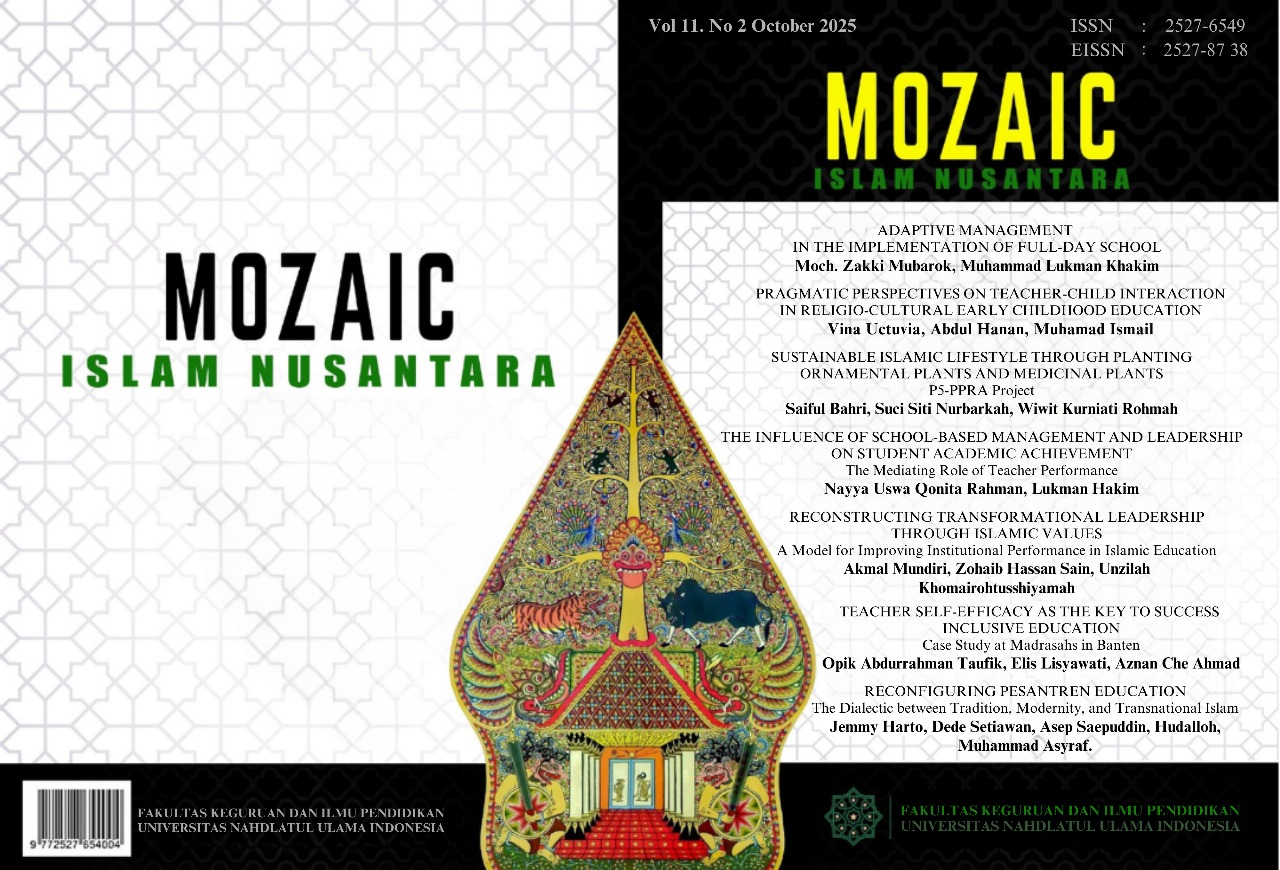
Sustainable Islamic Lifestyle through Planting Ornamental Plants and Medicinal Plants
P5-PPRA Project
DOI:
https://doi.org/10.47776/mozaic.v11i2.1825Keywords:
Ecotheology, P5-PPRA, Sustainable Character DevelopmentAbstract
Islamic education plays a significant role in shaping students who are faithful, knowledgeable, and morally upright. As formal educational institutions, madrasahs are expected not only to achieve intellectual excellence but also to cultivate social, spiritual, and ecological awareness among students. However, the integration of environmental education with religious values in madrasahs remains limited. This study aims to describe the implementation of the P5-PPRA Project towards an Eco Madrasah through the Sustainable Lifestyle theme, specifically through the planting and maintenance of ornamental and medicinal plants at MI Darul Ulum Bantaran, and to analyze the ecological and religious character values developed among students. Employing a qualitative descriptive approach, data were collected through observation, interviews, and documentation, and analyzed interactively following the Miles and Huberman model. The findings indicate that these activities successfully foster responsibility, cooperation, discipline, environmental awareness, independence, spiritual consciousness, and high student enthusiasm. Furthermore, the integration of Islamic ecotheology and fiqh al-bi’ah principles ensures that the learning process is contextual, practical, and effective in developing students’ eco-spiritual character. In addition, the successful implementation of these activities provides opportunities for developing entrepreneurial initiatives based on ornamental and medicinal plants, allowing students to generate beneficial products while enhancing their ecological and religious literacy. The P5-PPRA Project thus demonstrates an effective model for establishing Eco Madrasahs oriented towards environmental sustainability and the cultivation of religious values.
References
Anggito, A., & Setiawan, J. (2018). Metodologi Penelitian Kualitatif (D. E. Lestari, Ed.; 1st ed.). Cv Jejak.
Basri, S., Adnan, Y., Widiastuty, L., Asrul Syamsul, M., & Indar, I. (2024). Islamic Environmental Ethics: A Cultural Framework for Sustainable Resource Management and Global Ecological Stewardship. Diversity: Disease Preventive of Research Integrity, 5(2), 86–93. https://doi.org/10.24252/diversity.v5i2.52342
Citaningati, P. R., & Alfianto, T. (2024). Blue Economics in Islamic Economics Perspective: Fiqh Bi’ah Approach. Journal of Islamic Economic Laws, 7(02), 128–160. https://doi.org/10.23917/jisel.v7i02.5200
Cooper, N., Brady, E., Steen, H., & Bryce, R. (2016). Aesthetic and spiritual values of ecosystems: Recognising the ontological and axiological plurality of cultural ecosystem ‘services.’ Ecosystem Services, 21, 218–229. https://doi.org/10.1016/j.ecoser.2016.07.014
Direktorat KSKK Madrasah Direktorat Jenderal Pendidikan Islam Kementerian Agama RI. (2022). Panduan Pengembangan Projek Penguatan Profil Pelajar Pancasila Dan Profil Pelajar Rahmatan Lil Alamin (1st ed.). Subdit Kurikulum dan Evaluasi Direktorat KSKK Madrasah Direktorat Jenderal Pendidikan Islam Kementerian Agama RI. https://cendikia.kemenag.go.id/publik/buku_detail/709
Fibonacci, A., Azizati, Z., & Wahyudi, T. (2020). Development of Education For Sustainable Development (Esd) Based Chemsdro Mobile Learning For Indonesian Junior High School: Rate Of Reaction. Jurnal Tadris Kimiya, 5(1), 26–34. https://doi.org/10.15575/jtk.v5i1.5908
Hasan, M., Arisah, N., Ratnah S, Ahmad, M. I. S., & Miranda. (2023). Experiential Learning Model for the Development of Collaborative Skills through Project Based Learning Practicum. JPI (Jurnal Pendidikan Indonesia), 12(2), 340–349. https://doi.org/10.23887/jpiundiksha.v12i2.57376
Husamah, H., Rahardjanto, A., Hadi, S., Lestari, N., & Ummah BK, Muh. K. (2023). Spirituality-based environmental literacy among prospective biology teacher in Indonesia: Analysis based on gender, accreditation, and semester-level aspects. JPBI (Jurnal Pendidikan Biologi Indonesia), 9(3), 418–432. https://doi.org/10.22219/jpbi.v9i3.29500
Ikhsan, F. A., Kurnianto, F. A., Apriyanto, B., Nurdin, E. A., & Bachtiar, R. W. (2019). The effectivity of environmental education in scaffolding students’ ecological literacy. Jurnal Pendidikan IPA Indonesia, 8(3), 398–406. https://doi.org/10.15294/jpii.v8i3.14522
Indriyani, R. (2025). Menag Minta Ekoteologi Jadi Paradigma Baru PTK Bangun Generasi. Kementrian Agama Republik Indonesia. https://kemenag.go.id/nasional/menag-minta-ekoteologi-jadi-paradigma-baru-ptk-bangun-generasi-RAUZe
Istiani, M., & Muhammad Roy Purwanto. (2019). Fiqh Bi’ah Urgensi Teologi Al-Quran. At-Thullab: Jurnal Mahasiswa Studi Islam, 1(1), 27–44. https://doi.org/10.20885/tullab.vol1.iss1.art2
Jamalaudin. (2018). Fiqh Al-Bi’ah Ramah Lingkungan: Konsep Thaharah Dan Nadhafah Dalam Membangun Budaya Bersih. Tribakti, 29(2), 324–346. https://doi.org/10.33367/tribakti.v29i2.600
KLH. (2025, June 22). Hentikan Polusi Plastik: Menteri LH Dorong Kolaborasi Nasional dalam Expo dan Forum Hari Lingkungan Hidup Sedunia 2025. Kementrian Lingkungan Hidup/ Badan Pengendalian Lingkungan Hidup. https://kemenlh.go.id/news/detail/hentikan-polusi-plastik-menteri-lh-dorong-kolaborasi-nasional-dalam-expo-dan-forum-hari-lingkungan-hidup-sedunia-2025?utm_source=chatgpt.com
Kurniawan, A. (2025). Hadits Seputar Keutamaan Menanam Pohon Sumber. NU Online. https://islam.nu.or.id/ilmu-hadits/hadits-seputar-keutamaan-menanam-pohon-YmVMN
Kusumastuti, A., & Khoiron, A. M. (2019). Metode Penelitian Kualitatif (1st ed.). Lembaga Pendidikan Sukarno Pressindo.
Laksono, G. E. (2022). Mewujudkan Kesadaran Lingkungan melalui Pendidikan Agama Islam berbasis Ecotheology Islam. Jurnal Kependidikan, 10(2), 247–258. https://doi.org/10.24090/jk.v10i2.8043
Margolis, A. A. (2020). Zone of Proximal Development, Scaffolding and Teaching Practice. Cultural-Historical Psychology, 16(3), 15–26. https://doi.org/10.17759/chp.2020160303
Matthew, Huberman, A. M., & Saldana Jhonny. (2014). Analisis Data Kualitatif (3rd ed.). Universitas Indonesia Press.
Mergaliyev, A., Asutay, M., Avdukic, A., & Karbhari, Y. (2021). Higher Ethical Objective (Maqasid al-Shari’ah) Augmented Framework for Islamic Banks: Assessing Ethical Performance and Exploring Its Determinants. Journal of Business Ethics, 170(4), 797–834. https://doi.org/10.1007/s10551-019-04331-4
Mujlipah, N., & Setiawan, D. (2024). Nilai-nilai Moderasi Beragama dalam Film Pendek Rukuh dan Relevansinya dengan Pendidikan Agama Islam. Mozaic : Islam Nusantara, 10(2), 99–114. https://journal.unusia.ac.id/index.php/mozaic/article/view/1097
Murad, F. A. (2017). Environmental Corruption: Definition, Aspects and the Islamic Stand. Journal of College Of Sharia & Islamic Studies, 35(1), 147–200. https://doi.org/10.29117/jcsis.2017.0176
Nafisah, M. (2019). Tafsir Ekologi: Menimbang Hifẓ al-Bīah sebagai Uṣul ash-Sharī’ah dalam Al-Qur’an. Al- Fanar : Jurnal ILmu Alquran Dan Tafsir, 2(1), 94–111. https://doi.org/10.33511/alfanar.v2n1.93-112
Nasir, N. M., Nair, M. S., & Ahmed, P. K. (2022). Environmental Sustainability and Contemporary Islamic Society: A Shariah Perspective. Asian Academy of Management Journal, 27(2), 211–231. https://doi.org/10.21315/aamj2022.27.2.10
Nu Online. (2025). Albaqarah Ayat 30. Nu Online. https://quran.nu.or.id/al-baqarah/30
O’Grady, M. (2025). Transformative education for sustainable development: A faculty perspective. Environment, Development and Sustainability, 27(9), 20745–20761. https://doi.org/10.1007/s10668-023-03609-y
Pollin, S., & Retzlaff-Fürst, C. (2021). The School Garden: A Social and Emotional Place. Frontiers in Psychology, 12, 1. https://doi.org/10.3389/fpsyg.2021.567720
Putri, L. D., Nugroho, C., Malik, A., & Nastain, M. (2023). Developing ecological piety in pesantren: the Kyai’s cognition and the practice of living fiqh al-bī’ah in Banten. Ijtihad: Jurnal Wacana Hukum Islam Dan Kemanusiaan, 23(2), 235–259. https://doi.org/10.18326/ijtihad.v23i2.235-259
Rakhmat, A. (2022). Islamic Ecotheology: Understanding the Concept of Khalifah And the Ethical Responsibility of the Environment. Academic Journal of Islamic Principles and Philosophy, 3(1), 1–24. https://doi.org/10.22515/ajipp.v3i1.5104
Riivari, E., Kivijärvi, M., & Lämsä, A. M. (2021). Learning teamwork through a computer game: for the sake of performance or collaborative learning? Educational Technology Research and Development, 69(3), 1753–1771. https://doi.org/10.1007/s11423-021-10009-4
Salsabila, A., Maulidar, & Saudah. (2024). Implementasi Projek Penguatan Profil Pelajar Pancasila Pada Tema Gaya Hidup Berkelanjutan Berbasis Ecoprint Terhadap Dimensi Kreatif Siswa Kelas IV SD Negeri 5 Banda Aceh. Arini: Jurnal Ilmiah Dan Karya Inovasi Guru, 1(1), 17–32. https://doi.org/10.71153/arini.v1i1.88
Sarie, F., Untarti, A., Amrullah, M. N. K., Syah, R. F., Amruddin, Pranoto, W. A., Back, S. W., Arini, D. U., Lestari, K. K., & Saksono, H. (2023). Mengenal Ekologi Sosial (1st ed.). Yayasan Cendikia Mulia Mandiri.
Sugiyono. (2022). Metode Penelitian Pendidikan Pendekatan Kuantitatif, Kualitatif dan R&D (2nd ed.). Alfabeta, CV.
Sultani, & Zamroni. (2024). Implikasi Pendidikan Lingkungan Ramah Anak Terhadap Penguatan Karakter Siswa Madrasah Aliyah Negeri di Kota Bontang. Al Riwayah, 16(1), 152–166. https://doi.org/10.47945/al-riwayah.v16i1.1219
Tireli, Ü., & Jacobsen, J. C. (2023). Critical Pedagogy and Children’s Engagement with Climate Change: The Importance of the School and the Teacher. Journal of School Administration Research and Development, 8(1), 55–64. https://doi.org/10.32674/jsard.v8i1.2785
Valls-Carol, R., Rodrigues de Mello, R., Rodríguez-Oramas, A., Khalfaoui, A., Roca-Campos, E., Guo, M., & Redondo, G. (2022). The Critical Pedagogy that Transforms the Reality. International Journal of Sociology of Education, 11(1), 58–71. https://doi.org/10.17583/rise.8900
Wicaksono, R. A. (2023, March 23). Hari Hutan Sedunia: Deforestasi Indonesia 2023 Capai 257 Ribu Ha. Betahita. https://betahita.id/news/detail/10044/hari-hutan-sedunia-deforestasi-indonesia-2023-capai-257-ribu-ha.html?v=1718774932
Downloads
Published
Issue
Section
License
Copyright (c) 2025 Saiful Bahri, Suci Siti Nurbarkah, Wiwit Kurniati Rohmah

This work is licensed under a Creative Commons Attribution 4.0 International License.



.jpg)