Akreditasi
CERTIFICATE
Submission
Index
Policies
Index
Visitor
Praxis: Jurnal Pengabdian kepada Masyarakat is committed to maintaining the quality, integrity, and relevance of scholarly publications through a fair, transparent, and constructive peer-review process. Peer review helps ensure that published manuscripts meet appropriate academic standards and contribute meaningfully to the development of community service practices and community empowerment.
The peer-review process is intended not only to assess the suitability of a manuscript for publication but also to help authors improve the clarity, methodological rigor, relevance, and overall quality of their work. Requests for revision are a normal part of scholarly publishing and should be regarded as an opportunity to strengthen a manuscript rather than solely as an obstacle to publication.
The journal follows recognized publication ethics principles, including the ethical guidance of the Committee on Publication Ethics (COPE), in conducting its review process.
Peer review is an essential component of scholarly publishing. It provides an independent assessment of a manuscript's quality, relevance, and contribution to its field. At Praxis, the review process aims to ensure that community service articles provide clear descriptions of the problems addressed, the methods employed, the implementation process, the outcomes achieved, and the implications for community development.
The review process takes into account the distinctive characteristics of community service publications. In addition to academic quality, reviewers assess the relevance of the community needs addressed, the appropriateness of the implementation methods, the evidence supporting reported outcomes, the benefits for the target community, and the potential sustainability or wider applicability of the program.
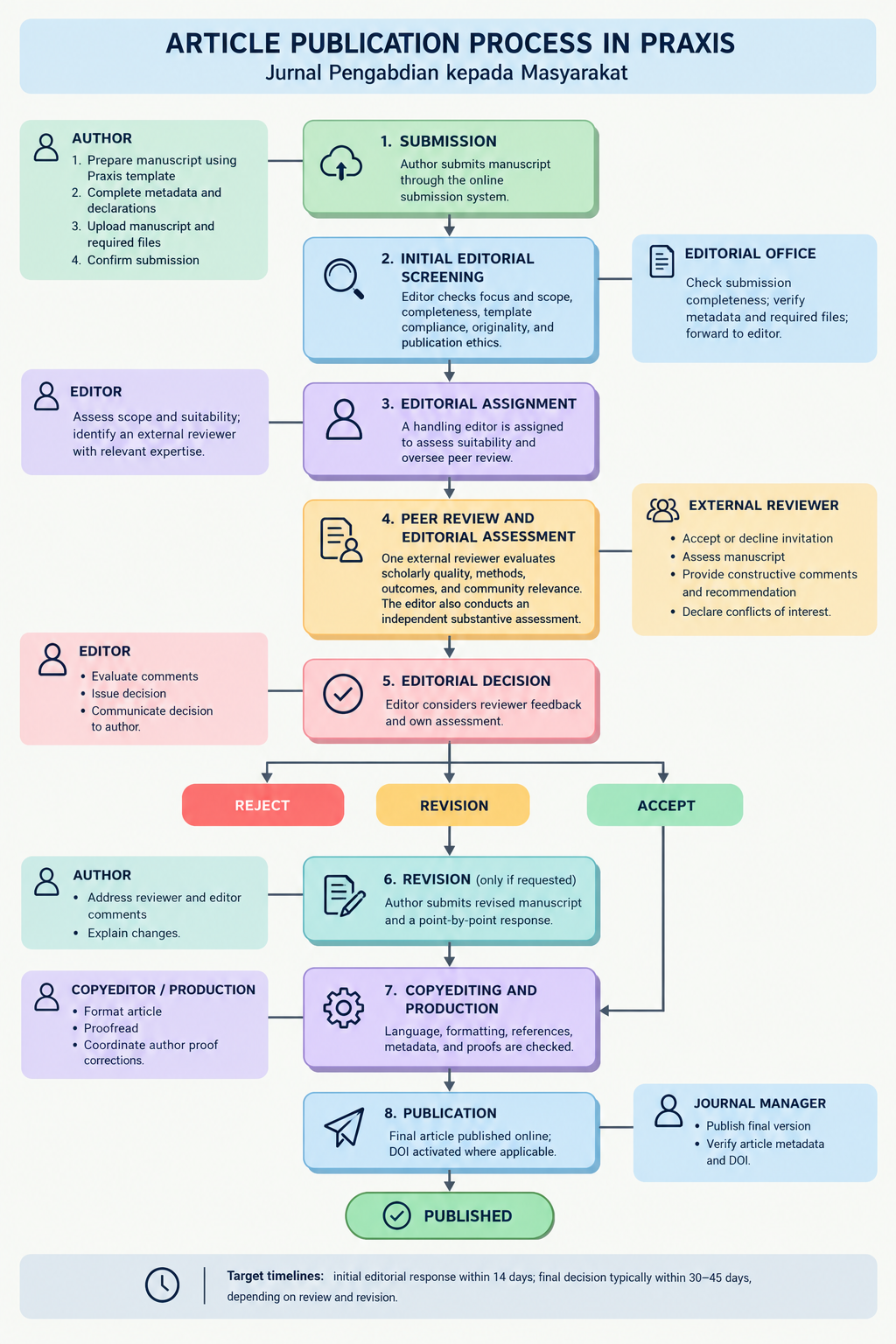
The review process generally follows these stages:
Initial Editorial Screening: The editor checks the manuscript's relevance to the journal's focus and scope, compliance with the manuscript template, completeness of the submission, originality, and adherence to publication ethics requirements.
External Review: The manuscript is evaluated by an external reviewer with relevant expertise. The reviewer provides constructive comments and recommendations regarding the manuscript's strengths, weaknesses, and suitability for publication.
Editorial Assessment: The editor considers the external review, evaluates the manuscript independently, and determines the appropriate editorial decision.
Revision: When revisions are required, the authors are invited to address the reviewers' and editor's comments and submit a revised manuscript.
Final Decision: The editor evaluates the revised manuscript and determines whether it should be accepted, returned for further revision, or rejected.
Editorial decisions are based on scholarly merit, relevance, methodological appropriateness, ethical compliance, and the quality of the manuscript. Submission does not guarantee acceptance.
All reviewers and editors involved in the evaluation process are expected to uphold the following ethical standards, consistent with COPE guidance.
Praxis aims to process submissions efficiently while maintaining appropriate standards of editorial assessment and peer review.
Initial Editorial Response: Within 14 days of manuscript submission.
Final Editorial Decision: Typically within 30–45 days of submission, depending on reviewer availability, the complexity of the manuscript, and the time required for revisions.
These timelines are targets rather than guarantees. The final decision may take longer if additional review, clarification, or revision is necessary. Authors should be informed of significant delays where appropriate.
If an author has not received an initial response within 30 days of submission, they may contact the editorial office at:
Email: praxis.jpkm@unusia.ac.id
CERTIFICATE
PRAXIS: Jurnal Pengabdian Kepada Masyarakat |P-ISSN: 2963-170X | E-ISSN: 2963-9115| is published by Lembaga Penelitian dan Pengabdian Masyarakat (LPPM) Universitas Nahdlatul Ulama Indonesia| email: praxis.jpkm@unusia.ac.id | Address: Jl. Taman Amir Hamzah No. 5 Jakarta Pusat 10430 (Kampus A); Jl. Parung Hijau Pondok Udik, Kemang Kab. Bogor (Kampus B)